Black Community Engagement Person of the Month – Laurabel Mba
Laurabel Mba: Educator, Advocate, and Community Builder
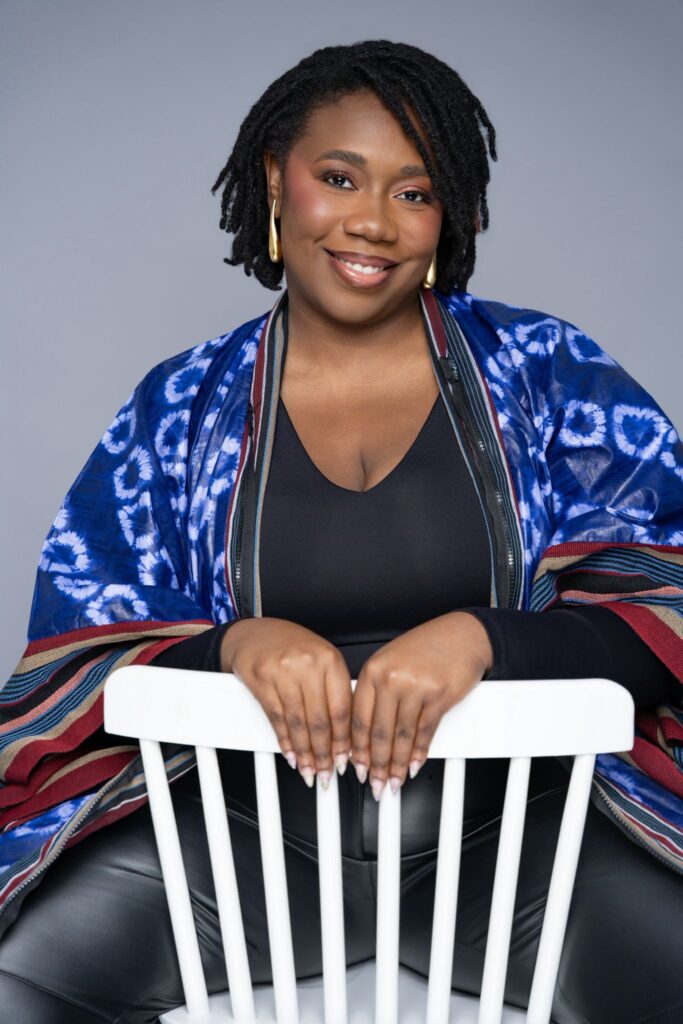
Each month, the Association for New Canadians’ Black Community Engagement Program celebrates an individual whose work is shaping a more inclusive Newfoundland and Labrador. This month, we are proud to spotlight Laurabel Mba, a woman whose journey from Nigeria to the shores of NL has become a story of resilience, purpose, and unwavering commitment to community.
As an anti-racism educator, DEIB strategist, and entrepreneur, Laurabel has spent a decade helping organizations build cultures where everyone truly belongs. She is the Owner/CEO of Laurabel Mba Consulting and a familiar face to many as co-host of Out of the Fog on Rogers TV. Whether she is in a boardroom, a classroom, or on the campaign trail, where she made history as the first Black woman to contest a seat in the NL House of Assembly, Laurabel shows up fully and asks others to do the same.
We connected with Laurabel to talk about her roots, her motivations, the barriers she has faced, and the future she is working to build for her son, Theo, and for all of us.
On Roots, Motivation & Identity
Can you share a bit about yourself?
My name is Laurabel Mba. I am a mom. I am originally from Nigeria. I lived in Ontario, Alberta, and I now call Newfoundland and Labrador home. I am the owner and founder of Laurabel Mba Consulting, which is an anti-racism, diversity and equity consultancy.
You’re an active (and often lead) participant in multiple (intersecting) community spaces. What experiences or moments in your life first inspired you to engage in anti-racism and equity work within your community, and how did this become the center of your work so far?
Well, as someone who moved to Canada when I was eight, I became very aware that my identity as a Black woman was not going to prevent me from being who I thought I could be, but it would be the leading aspect of my identity when I walked into a room, even though I’ve thought other aspects of me were important. That was all fine, and my parents had raised me to know how to navigate those spaces with that as the leading identity for me. But then, in 2019, I had the honour of having my first child, Theo, and then I thought I would have a little bit more time before I had to face the realities of raising a racialized son in a predominantly white province. But then 2020 happened, and the global community watched the murder of George Floyd, and then I realized I didn’t have time anymore. So, my son has become the greatest inspiration for why I do the work that I do. Not just because I want him to live in a better world, but because I think all children deserve the opportunity to show up as full beings and not have aspects of their identity marginalized in how they get to show up in a space. So, I think that has inspired a lot of the work that I do. It wasn’t what I thought I’d be doing in this world, but it’s work that I’m honoured to be able to do.
On the Path to DEI
You’ve done extensive work in diversity, equity, and inclusion training—can you share some of the most impactful changes you’ve seen so far that are a result of your efforts?
I think – I’m not even sure that I can say it’s the change that I’ve seen in terms of how society has changed, but the changes that I see in the rooms of the people that I get to speak to when I walk into the room, versus when I’ve done a training.
I think one of the most impactful things for me was a conversation that I got to have at an elementary school. One of the young women at the end of the program said thank you for giving her the opportunity to show up fully as herself. For me, that was a really heartwarming moment, because I remembered what it was like for me to be a young Black child in a classroom and feel like I had to hide and edit parts of myself to show up in the spaces that I had to be in.
And then most recently, I got the opportunity to speak to a room full of adults. When it was over, someone came up to me and said, “Thank you for changing my point of view, and for allowing me to see a world that I don’t always get to live in, but where the people I care about exist.” So, I think those are the changes that keep it going. It’s not about the big change; it’s the little micro moments that allow people [to] shift the way they think.
We are now having different conversations, and I’m very grateful that, if nothing else, I get to inspire different conversations for people, even when I’m not in the room.
On Community Impact
Can you share a specific initiative or project you led that had a meaningful impact on the Black community or other marginalized groups?
Oh, that is hard…if I could think of anything specific, it’s the current push to make Black History Month acknowledged and celebrated within the education system. I know that there is now a larger population of Black Newfoundlanders and Labradorians, both born here and who have emigrated here.
I think it is important for them to know that their history is important and valid and should be celebrated, and Black history is not just the history of slavery and enslavement and the transatlantic slave trade, but the history of math, science, art, history and geography. People need to know that Black people have contributed to the history of the global population. I would like people to know more about that.
On Being a Racialized Leader Within and Outside Your Community
As a Black woman working in private and public professional spaces, what unique challenges have you faced?
Oh, everything from how my hair looks when I show up in a workspace when I was not self-employed to the oversexualization of the Black female body, to people being surprised that I speak English as eloquently as they think I do.
Those are some of the challenges, but I think, if nothing else, I’m not the first one who faced them. If perhaps I’m the first person, then individuals who have presented these ideas that I talk to, I’m hoping that they know that there are many more Black people like me who wear their hair in the natural state that it is, whether it’s an afro, locs or braids, and all of those are professional.
Whether they are surprised by how good our English is, we’ve been colonized by the British for the majority of us, so English is a first language for a lot of us, and if it’s not English, it’s French because colonization happened from multiple European countries. It’s the way that people have looked at our bodies, it’s to know that human bodies are human, and no one deserves to be oversexualized because you are new to how they show up in a space.
How do you navigate resistance to social change in your line of work?
Change is going to happen, and one of the things that I’ve had to acknowledge and understand is that human beings are afraid of change. We like things to stay the same as we have been used to, but if we remind people that the only thing that is constant in human existence is change, then we’re going to be a lot more willing to accept the changes that we see show up in the world. So, I’m aware that people are going to be hesitant to see the change that is occurring, but my role with the job that I do is to remind them that change is constant, and you just have to be prepared for it. Know how to deal with it and support it when it leads to a greater good.
On Political Candidacy and Barriers
What motivated you to run for office in the NL House of Assembly? What did the experience teach you about representation and leadership?
What motivated me to do it? It was a conversation I had with my family after I had been asked. They told me, “If not you, then who?” And then I thought about that really hard, and then I might not be the most perfect candidate, but if I can do it, it then shows those who want to (do so) that they are capable. So I had nothing to lose. I happened to be sitting in a position where my employment was not going to be at risk. My child was old enough that I had enough support systems to call on if I needed help with him at that point in time. So, I did. When I think about what I learned from that experience, as someone who likes to be behind the scenes and serve the community, it was very hard for me to call on my community for support, but I was shocked by the amount of support that I received.
From those who could help, from those who couldn’t, from the student population, from the immigrant population, from across the world and across the country, and even right here at home…from people I never thought would stand beside me, would knock on doors. Show up. I had volunteers as old as 80 knocking on doors, to youth posting on social media who had never done so before. So, it taught me a lot. If you show up for your community, even when you don’t think they’re ready to show up for you, you need to give them the opportunity to.
Being the first Black person in your community to contest for that office is significant—what systemic or social barriers did you encounter during your campaign?
This is a really hard question because I really don’t like to talk about the hard things that came up in the campaign. But one of the things that was really prevalent for me was the amount of money that it takes to run in an election, and I like to think of myself as the everyday person. I come from paycheck-to-paycheck people. People who are not known for having generational wealth, and so having to go back to the community to ask for financial support for me as the cause (for me) was something that was a little bit uncomfortable.
Also, thinking about the electoral system and the way elections are run is not always very inclusive for women. The times that we’re knocking on doors were after 5pm, which is when a lot of women happen to be in childcare situations – schools closed, daycare closed, and that’s when we’re supposed to be taking care of our family. So having to do that was particularly hard. And being racialized didn’t make it any easier. Newfoundland and Labrador has never elected a visibly racialized individual to the House of Assembly, and so one of the things that came up as I was going door to door was that as much as Newfoundland and Labrador has been the place that I have lived the longest, people told me they wanted a “good ol’ Newfoundlander and Labradorian girl” to sit in the House of Assembly, and I didn’t look like that, so that was a bit difficult to take. But it made me realize that people need to understand that the faces of Newfoundlanders and Labradorians look different than they did five, ten, or twenty years ago. Now, my face is the face of the average Newfoundlander and Labradorian, and so it’s time for it to be represented in our government.
On Advice for Future Leaders
What advice would you give to young Black individuals or other racialized people who aspire to leadership roles in activism or politics?
To young folks, irrespective of your gender make-up, your gender identity, your ethnic make-up or your sexual identity, I would say figure out what matters to you. What things do you value? What impact do you want to have on the world? And when you figure that out, do it in the way that is most authentic to you. It’s not so much about the big lights, the camera, the titles, or any of that. What’s important is that you get to leave the world a little bit better than you found it. That you get to build a community with people who care about you and those you care about, too. And when you do that, you might find yourself in a leadership role that you didn’t expect.
A leader looks different. They’re not always the loudest voice in the room. They’re not always the most confident person. But they are always helpful. So, help in a way that feels natural to you. Find the spaces in which you’re welcomed, and even if you’re in a space that might not feel like you’re most welcomed in, remember that your voice is valuable and that it deserves to be heard. So, use it in a way that feels most authentic to you. If that way is a whisper or a yell, do whatever feels right, and the world would be very grateful that you did.
On Vision for the Future
Looking ahead, what changes would you most like to see in your vision of an Ubuntu society?
When I look ahead, and I think of the idea of Ubuntu, I think I want a world where people get to show up. That the aspects of them that are valued are…I would think back to when Martin Luther King gave his speech, and he wanted people to be valued for the content of their character and their heart. That is what I want. I want people to show up in society. I know again, varied experiences are what the world wants to see. I want people to find community wherever they are and not feel like they must perform to be accepted. I don’t want a transactional society.
So, I think of a world where little me would have had the ability to keep a sparkle in her eye; where my son can show up and be as brave or as bold or as quiet as he wants to be and still be considered valuable. I think of those who have disabilities but still add so much to the society they exist in. I think of migrants who show up in spaces far from their places of origin, yet still give so much of themselves. I think of a world without borders. I think of Turtle Island. I think of land back. I think of a society where human life is valued, and regardless of our differences, we still recognize humanity in each other.
What type of legacy would you like to leave behind?
I always laugh when I hear the word “legacy,” and then I think of myself as a legacy. People think of legacy as this thing that happens years down the road after you’ve left. I think of legacy as the second thing you leave behind after you leave a room. So, when I think of my own legacy, I hope people know that if I were in their space, they would be loved. If I were in a space, they would be valued. If I were in their space, they would be respected, and if I were in their space, I would see the magic that existed in them. And so, when people talk about me when I leave a room, I hope that they say, “she saw me. She knew me. She recognized me, and she valued me, and because she did, I can”. So that they can value themselves and recognize the magic within themselves. And then they get to recognize the magic within the people who stand beside them.